
G8JNJ
About
- Username
- G8JNJ
- Joined
- Visits
- 4,661
- Last Active
- Roles
- Member
- Points
- 130
Reactions
-
My Kiwi and the ground
If you are using an unbalanced antenna, it needs something to provide the "missing" half, that would otherwise be present in a balanced antenna. All simple antennas are basically dipoles. It's just that sometimes you can't figure out where the missing bit is, but it's always there !
The trick with unbalanced antennas is to provide the "missing" half in a controlled manner, and not to let random conductors, which may be polluted with noise from other sources, provide it.
Use a separate "clean" earth at the base of the antenna, and choke off unwanted noise that may be present on the feedline, by means of strategically placed common mode chokes and maybe additional "clean" earth connections along the cable route, as this improves the rejection by working a bit like a potential divider network.

Burying the coax can also help, as this provides both additional shielding and a low impedance path to ground.
Balanced antennas with good common mode rejection are nearly always better performers, and low impedance balanced antennas, such as broadband loops, tend to have intrinsically good common mode rejection characteristics.
Regards,
Martin

-
HT004a / LNA / Anyone used one?
Looking at the AliExpress pictures, it would seem to use a Qorvo TQP3M903 700 - 6000 MHz Ultra Low Noise, High Linearity Low Noise Amplifier
https://www.qorvo.com/products/p/TQP3M9037
Although many devices of this type can operate outside their specified parameters, it is difficult to tell how well this may work, without testing one in a specific application.
In this case, I suspect the IMD performance degrades outside the specified frequency range, and may not be adequate at short wave frequencies. I have used similar devices as the basis of an active antenna, but they easily overload if connected to anything other than a very small antenna element.
It's tricky to find a cheap commercial amplifier that has adequate performance to use ahead of the KiWi. I build my own design of RF distribution amplifier, and it was quite an undertaking to achieve decent IMD performance on the LF bands, whilst still having a good noise figure on the HF bands. In the end I used two separate amplifier chains, with diplexing filters to split the frequency ranges, but it is still barely adequate when connected to a decent antenna.
Regards,
Martin

-
Is my KiwiSDR about to fail?
I'd suggest checking your power supply, as an initial part of any investigation..
I've had similar problems, and it's nearly always turned out to be power supply related.
On particular problem is poor quality electrolytic capacitors that "dry" out over time, and the power supply smoothing and regulation suffer as a result. This is not always immediately obvious, but sometimes becomes more apparent when the KiWi and Beagle draw more current during certain operations.
Regards,
Martin
-
Alpha (RSDN-20) navigation: Krasnodar, Novosibirsk, Khabarovsk active

-
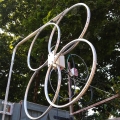
LZ1AQ Active Amp and a "Fat" Lazy loop - Dual Opposing Loops.
Broadband loops don't have to be mounted that high above the ground. 2m is about the optimum, and my loops are actually ground mounted in among some bushes.
The key thing is to get them as far away as possible from potential noise sources. They don't significantly interact with nearby objects, which means that you can often locate them in spots that would not be suitable for other types of antenna.
In addition, you can rotate them so that local noise sources are nulled out, and moving them slightly can help ensure that the null does not fall in a desired direction.
Keep experimenting until you can't easily obtain further improvements.
Regards,
Martin