
G8JNJ
About
- Username
- G8JNJ
- Joined
- Visits
- 4,662
- Last Active
- Roles
- Member
- Points
- 130
Reactions
-
Very wideband FSK(?) on 40m
Well done on the TDoA, especially as it doesn't work too well on CW or FSK. I made several TDoA runs during grey line propagation, and initially thought it was from Germany. I should have known better. I used two separate browser instances with my KiWi, with the frequencies offset to produce a composite, but much narrower shift FSK signal, that I could attempt to read with an external decoder. However, the data is encrypted, as you would expect for a military signal.
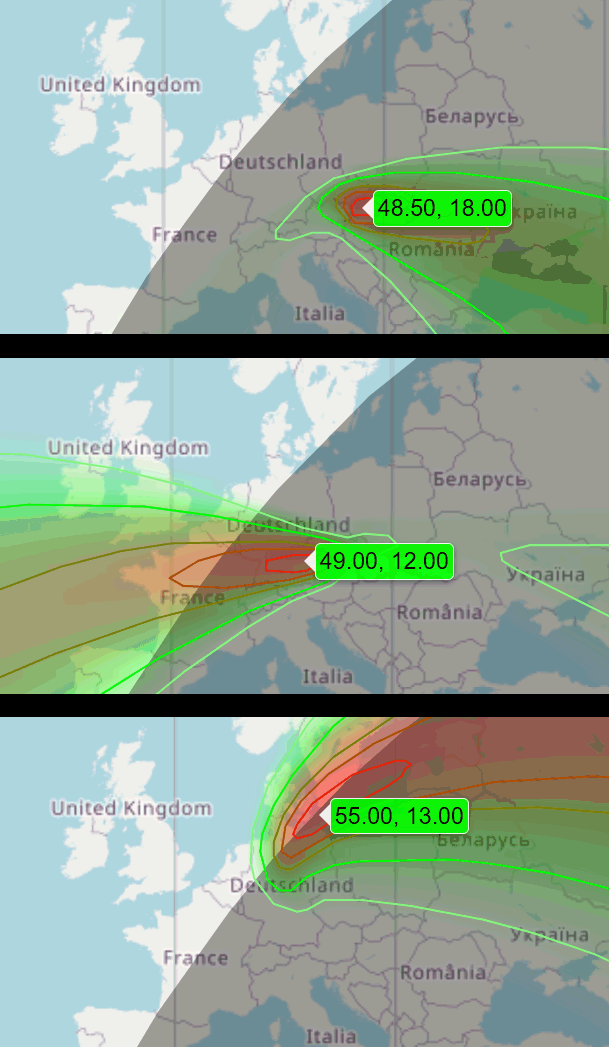
The pair on 7043/7050 kHz shift to 7041.5/7048.5 kHz
The pair on 7063/7070 kHz shift to 7061.5/7068.5 kHz
Reports and discussion suggest it's a Russian FSK transmission, with some reports suggesting it's coming from somewhere in the Urals or the heart of Siberia, but one more detailed report suggests that the source is in the Crimea near Sevastopol ( https://youtu.be/zRho2iFfBCE )
--- Text from YouTube video---
Sevastopol; Extremely powerful two channel 20b/7000 Hz FSK paired signals re-appear from Apr 23rd on 40m band ~ 7045cf and 7065.5cf, each channel seems to be 7 kHz from mark and space, chosen for it's immunity from being easily jammed, at times the pair will shift frequency; originating from Eastern EU / Western RU region, now Crimea with transmitters near Sevastopol. The modulation rate of 20b with a shift of 7000 Hz.
-The signal frame is 17 bits, the first of which is a 0.
-The superframe is 15 frames (255 bits) and is constantly repeated so it does not appear to carry any useful information
Military encryption 5N1 use in related signal connection to the conflict between Ukraine and Russia is likely. Contributor ANgazu thank you for your analysis!
---
This link has a similar discussion and explanation as to these signals:
https://reflector.sota.org.uk/t/some-weird-cw-found-on-40m/38289?u=iu1kgs
-
Number station on 8992Khz?
It's a common US HFGCS frequency, and they are sending an encoded Emergency Action Message (EAM)
Nothing to worry about (yet) these are very common transmissions.
But I'm pleased your SNR is creeping up :-)
Regards,
Martin

-
Sitting my Ham license :-)
Good luck.
I don't use mine that much, but if you are interested in radio, it's always handy to have an amateur licence.
In the past, it used to be a valuable "pseudo" technical qualification when seeking employment, but those days are long gone.
Have fun,
Martin
-
HT004a / LNA / Anyone used one?
Before anyone gets their credit card (or other method of payment) out. Make sure you actually need a pre-amp.
In most cases, you will not, they are useful in specific situations, but unfortunately for the majority of KiWi owners, local noise and interference will be the limiting factor, and no amount of pre-amplification or filtering, can improve or remove, what is present, and intertwined with the desired signals.
One test, I suggest, is to make a note of your receiver noise floor with a screened 50 ohm load connected in place of your antenna. Then connect your antenna, and measure the noise floor again. Typically, do this on the HF bands, in a quiet chunk of spectrum, somewhere between 25 to 30MHz.
If the difference in noise floor readings is less than 6dB, you may benefit from using a better antenna, or in some cases a pre-amplifier.
If it is 6dB or more, then your system is already noise limited by your antenna and local environment, and this may be the best you can achieve. Any further improvement can only be brought about by using a better antenna, or by reducing the amount of noise present by some other method.
If the increase in noise is 10dB or more, then it is likely that you have a lot of noise and interference present, and this will be severely limiting reception. This may be because you are using a pre-amplifier ahead of your receiver, which is probably providing too much gain, and it will not further improve the sensitivity of your receiver, but it will be degrading the overall Dynamic Range, susceptibility to overload, and generation of spurious IMD products.
Unfortunately, because of the way that natural and galactic noise is distributed across the spectrum from 100kHz to 30MHz, the noise floor at 1MHz can be 20 to 30dB higher at 1MHz with respect to 30MHz. If you add a pre-amp to improve performance on the HF bands, the likelihood is that it will be providing excessive gain on the LF bands.
Many amateur band transceivers have different attenuator and pre-amplifier settings, that are automatically changed when a different frequency range is chosen. For example, on 1.8MHz a 10dB attenuator may be applied, whereas on 28MHz a 20dB pre-amplifier may be used.
When using a KiWi, which provides continuous coverage from 0 to 30MHz, we can't use this method. So the best alternative is to use a frequency / amplitude equaliser, or shelf filter, that provides a gradually rising amount of gain with frequency (actually an increasing amount of attenuation as the frequency decreases). By doing this, we can try to match the filter characteristic, with changes in the natural noise floor, so that we only provide as much gain as necessary at any given frequency.
In a practical installation, we also have to take into account the frequency response of the antenna, and it's gain characteristics. But this usually only requires a slight modification to the filter response.
This is a link to an old article entitled "Noise equalization in h.f. receiving systems" written by D. C. Bunday, a UK GCHQ engineer, way back in 1977. It explains the concepts very clearly, along with practical circuits. Although the notes refer to problems associated with Analogue receive systems, they are equally applicable to modern day SDR's and digital Short Wave receivers.
https://www.worldradiohistory.com/UK/British-Institution-of-Radio-Engineers/1977/TREE-1977-05.pdf
Regards,
Martin



-
HT004a / LNA / Anyone used one?
That amplifier uses the same Qorvo TQP3M903 device, so I'd assume it's the same circuit too.
As before, the IMD performance isn't really sufficient for use ahead of a KiWi.
SV1AFN produces some good amplifiers that work well.
Although no longer a standard product, on request, he can also produce active splitters using push-pull pairs of FET's that work well. They have been successfully used at the Weston KiWi cluster, where we previously had severe problems with strong medium wave signals from nearby transmitters.
Turn Island Systems also produce a filtered pre-amp, using a Mini-Circuits device. Although the IMD specification is not too good, the use of a shelving and low pass filter ahead of it, minimises the performance issues.
I have no commercial interest in these companies, and do not specifically recommend them. I have simply highlighted them because of their characteristics, which may make them useful to KiWi owners.
Regards,
Martin