
G8JNJ
About
- Username
- G8JNJ
- Joined
- Visits
- 4,662
- Last Active
- Roles
- Member
- Points
- 130
Reactions
-
Low noise amplifier (LNA)
If you are using a T2FD at low height, you may possibly benefit from an LNA.
A lot depends on your local circumstances and level of background noise and interference.
The KiWi has a noise figure of around 14dB (from memory), which by itself is just about good enough for reception on the upper HF bands, providing a reasonable antenna is connected. This noise figure is more than adequate on the lower frequency bands, as the natural noise floor is much higher, and the receiver noise contribution becomes much less significant.
One test you can perform is to listen on a quiet HF frequency, typically between 20 and 30MHz, then make a note of the receiver noise floor, with the antenna connected, and then disconnected.
If there is an increase of 6dB, or more, with the antenna connected, then adding an LNA will not make any difference.
This is most likely because you have a high level of noise and interference, especially in an urban area, and your efforts would be better served by trying to locate and remote the sources of the noise, if at all possible. From experience, most high levels of noise, usually originate in your own home, or that of near neighbours, so you may stand a chance of improving things.
If the noise level doesn't increase by 6dB, then your antenna in not big or high enough, and adding an LNA may help. As is the case with "Loop on the Ground" or "Wire on the Ground" antennas, which by themselves have very low gain.
If you are using an LNA, then the test should be conducted by removing the actual antenna (or loop), and not the LNA output to the receiver, as it needs to include the additional LNA gain and noise contribution.
If you don't have an LNA connected, and have massively more than 10dB of increase in noise with the antenna connected, then you have serious noise problems, and these definitely need resolving.
If you do have an LNA connected, then it would be better to apply some attenuation, so that the noise increase is around 6dB, as this is the "sweet spot" in terms of system sensitivity vs. Dynamic range and IMD generation.
I hope this helps,
Martin

-
Surprised by interference.
Hi Trevor,
I don't think you need a filter, you have more than enough gain ahead of the KiWi, that allows you to simply add broadband attenuation.
You don't need massively strong signals to achieve good reception, you just need to get the balance right.
Once the overload is sorted out, which I think confused the issue, you can then start dealing with the remaining interference.
The pulsing noise that can be heard using AM demodulation, between about 15 and 26MHz is a Ethernet data over mains extender, and hopefully you may be able to null that out to a certain extent.
There is some noise with 50/100Hz modulation around 3MHz and other frequencies, which is probably a mains powered charger or some other similar electrical item. However, that is at a fairly low level and isn't causing major problems.
Overall, I'd say it's pretty typical of reception in a UK urban environment, and I think you would have to live in a much more rural location to obtain significantly better results.
When I moved from a quiet rural location, back into a town, my noise floor was about 20dB worse using the same types of antennas.
Regards,
Martin

-
Surprised by interference.
Hi Trevor,
I don't think your situation is quite as bad as you think it is.
I'd suggest sorting out the main issue first.
Your loop is providing quite high signal levels, and the two strong medium wave stations on 693 & 1053kHz are almost certainly causing some intermodulation products over the rest of the MW band, and maybe beyond.
Try adding 10dB of attenuation and see if this improves things.
In fact, you could probably add as much as 20dB, without degrading the Signal To Noise Ratio.
The antenna only needs to raise the noise floor by 6 to 10dB on the quietest of frequencies, which are probably those above 25MHz.
Adding 10dB of attenuation should reduce all the signals by 10dB, if some reduce by a greater amount, or disappear completely, then they are likely to be false signals produced as intermodulation distortion.
If intermodulation products remain, then the loop amplifier is being overloaded, and a smaller loop may be required.
Regards,
Martin

-
VDSL filter for the Kiwi SNR measurement
Ah OK, however it would be interesting to see if John's filter, also responds to broadband noise that looks like VDSL.
I wonder if there are several consecutive FFT bins, that contain the same level, could this be interpreted as wideband noise rather than individual signals, and treated as such in the SNR calculation ?
Regards,
Martin

-
What are these downchirp transmissions ?
These are typical of RF welding / Drying / Curing processes. Very high power RF sources are also used during some types of semiconductor manufacturing processes.
Another source, is from the cheap Chinese "Radio Frequency Facial Machine" or "wands". These typically produce between 5 to 25 watts, but some are rated at several hundred watts.
All of the above can usually be observed around most of the ISM allocations, and they are a good propagation indicator on the low VHF bands.
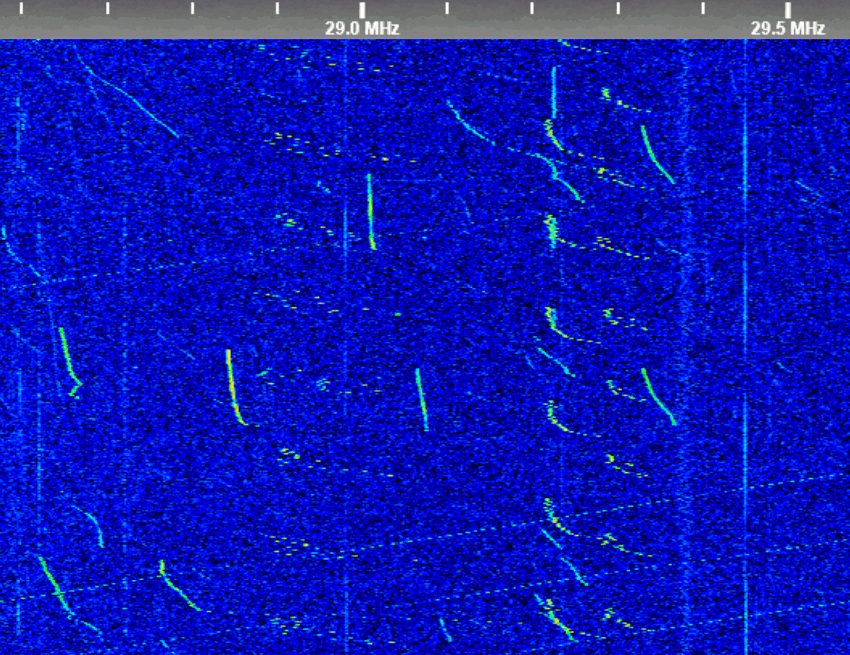
Here are a few that should really be in the 40MHz ISM band, most likely from Asia.
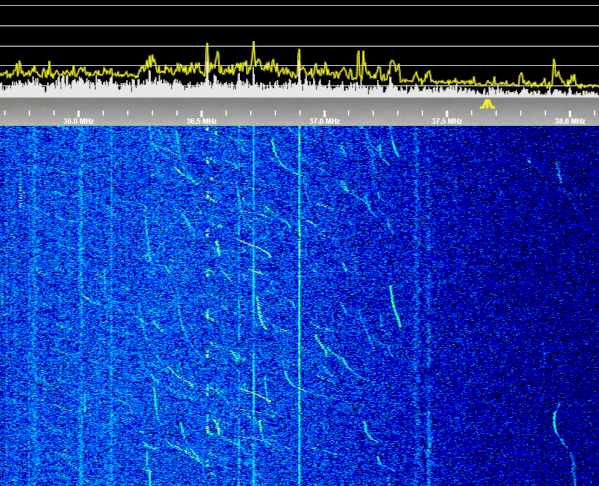
When I used to live in an industrial town, we had one in a factory that welded seams on industrial clothing, that operated on 27MHz, and the Interference Investigators were forever chasing the owners, as they often removed safety covers, so that they could run the machine for longer before it overheated. The stray RF signals and harmonics used to interfere with the 2m amateur band and local taxi services over a very large radius. Once you have heard the distinctive warbling, humming, and drifting signals, you can easily spot them again.
Regards,
Martin